Publications

ASMO: a decentralized and verifiable interoperability platform in intensive care
Frederik Berg, Marc Wiartalla, Moritz Hüllmann, Andreas Derks, Stefan Kowalewski, André Stollenwerk
Proceedings on Automation in Medical Engineering (AUTOMED 2023), 2023
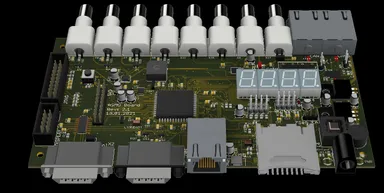
Interconnected medical devices enable new therapies and automate existing ones. Due to various manufacturers and interfaces, interoperability needs to be enabled with the help of auxiliary hardware. Since functional safety is indisputably critical, verifiability is essential, which is often neglected by state-of-the-art medical hardware platforms. We propose the ASMO hardware platform, which provides various interfaces to enable interoperability and where the workload is distributed such that the complexity of each unit can be reduced, while still providing enough capabilities for embedded machine learning. By using microcontrollers running an embedded real-time operating system, the verifiability can be further increased. The intrinsically created distributed architecture additionally allows for flexible rearrangement and efficient extension if needed.
A modular and verifiable software architecture for interconnected medical systems in intensive care
Marc Wiartalla, Frederik Berg, Florian Ottersbach, Jan Kühn, Mateusz Buglowski, Stefan Kowalewski, André Stollenwerk
Conference on Computer Science and Information Systems (FedCSIS 2023), 2023
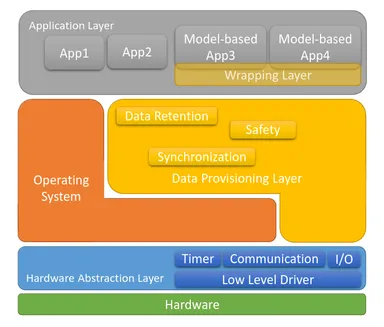
Medical device interoperability enables new therapy methods and the automation of existing ones. Due to different medical device manufacturers and protocols, we need auxiliary hardware and software for the interconnection. In this paper we propose a service-oriented software architecture built on a real-time operating system in order to create a modular medical cyber-physical system consisting of networked embedded nodes. In particular we highlight the need for the application of formal methods to ensure the functional safety of the system.
A fully automated normothermic machine perfusion system for kidney grafts supporting physiological motivated flow profiles
Marc Wiartalla, Frederik Berg, Jahn Kühn, Mateusz Buglowski, Stefan Kowalewski, André Stollenwerk, Christian Bleilevens
Current Directions in Biomedical Engineering (BMT 2023), 2023
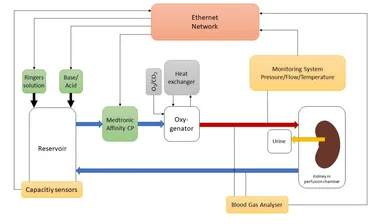
Research showed that the normothermic machine perfusion of kidneys can enable prolonged storage and improve conditions compared to traditional cold storage. For research in this area, there is a demand for a long-term in vitro perfusion setup. In this work, we present a fully automated normothermic machine perfusion (NMP) system as an experimental research platform. The perfusion system is intended as a tool for researching the effects of different perfusion strategies on the kidney. To enable the automation, the NMP system consists of a blood pressure control, a circulation volume level control and a pH-regulation component. The setup is realized as a medical cyber-physical system consisting of networked embedded microcontroller nodes.